91±¬ÁÏ

Updated
|
5 More Schools and Their Founders
A private school in its infancy is quite different from the mature community it becomes over time. I wonder what the founders of these five schools would think about them today. I bet they would be very proud of their creations.

It is fascinating to delve into the beginnings of a private school. It's when the school is so malleable and strongly influenced by its founder's zeal and lofty goals. The community is tiny compared to what it will morph into over the years, indeed over the centuries, in some cases. The hardships and sacrifices that are endured are almost unimaginable in this day and age. when new schools seem to pop out of a delivery box that is fully funded and all set to go.

I hope you will explore these five schools against the backdrop I have set out above. They are unique, as private schools always are. They have great personalities, characters, and rich histories. Yet they share a common theme and purpose: to provide their students the best well-rounded education so that their graduates can make a difference in today's world.

  • Founded in 1881
  • Number of students: 436
  • Grades PK-12: Boys and girls day school PK-8.
  • Girls boarding and day: 9-12
  • Religious Affiliation: Nonsectarian
  • Setting: Urban

Overview: The school was established by an Episcopal bishop. James Paddock with the financial support of businessman Charles Wright. Bishop Paddock named the school in honor of Wright's daughter, Annie. The school was a girls' school until the earthquake of 1949 damaged Lowell School, the local boys' school. AWS set up temporary quarters for boys. The coeducational program expanded to 8th grade in the 1970s.

AWS offers challenging academics, evidenced by

. . .read more

A Partnership of Three

Updated
|
A Partnership of Three
This article explores the three-way partnership between the school, parents, and students in boarding school education. It outlines the obligations and responsibilities of each party, emphasizing the importance of mutual support and commitment to ensure a successful boarding school experience.

Sending your child to boarding school is not as simple as dropping him off at school, giving him a teary hug and kiss, and then driving back home. Sending your child off to boarding school requires that you honor the contractual commitment that you signed when you decided to accept the school's offer of a place. Remember that binding, legal document called a contract? In it, you agreed to a partnership of three: the school, you, and your child. Let's look at what this arrangement involves.

The School's Obligation

The school spells out its obligations in great detail both on its website and in the various printed brochures and catalogs. The admissions staff will also discuss the school's various programs and school life with you when you visit and have your admissions interview. Most importantly, the school lists its obligations in the contract you and the school signed.

1. The school will offer the spelled out in its various materials. And it will ensure that the teaching is of the highest order. You expect nothing less. Private schools take academics very seriously. You won't have to worry about what will happen if the French teacher suddenly takes sick and has to withdraw. Her replacement will be in place quicker than you can say, "Je ne sais quoi".

2. The school will act in loco parentis while your child is in its care. It takes its responsibility very seriously. Their students' safety and well-being are

. . .read more

Why Small Class Sizes Work

Updated
|
Why Small Class Sizes Work
Learn why small class sizes at boarding schools improve academic performance, student engagement, and social development.

Small class sizes work. In fact, small class sizes are one of the main reasons why you send your child to boarding school. Here are some reasons why small class sizes are so important.

1. There's nowhere to hide in a small class.

Imagine your child is in a large high school class of 30-35 students. She's not good at math. Most of the students in her class don't understand math and could care less about it. So your daughter hangs out in the back of the class, keeps quiet and tries to pay attention. The distractions and cutting up going on around her mitigate against any meaningful learning. Your daughter falls further and further behind in math. Sadly, public school class sizes continue to increase in many districts as schools struggle with staffing shortages and budget pressures in 2026. Class sizes of 30-35 students remain common in many public high schools.

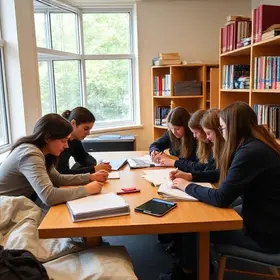
Contrast that learning environment with 12-14 students seated around a Harkness Table in a boarding school. A Harkness Table is an oval table. The teacher sits at the table with his students. Immediately students are placed in a situation where they have no choice but to engage and interact with each other and with their teacher. A Harkness table creates a climate for learning.

Implicit in the small teaching groups is a climate of tolerance. The views of each individual are expressed. Critical thinking skills are practiced and polished precisely because the small group allows time for that. Large groups make

. . .read more

5 More Founders and the Schools Their Gifts Established

Updated
|
5 More Founders and the Schools Their Gifts Established
Vision. Generosity. High-minded principles. These are the hallmarks of the benefactors of the five schools featured in this article.

In this article, we examine five more remarkable private schools established with a vision supported by munificence. The Phillips Family, which established the Phillips Academies at Exeter and Andover in the 18th century, had the purest motives in mind. They understood that a well-educated citizenry would ensure the future of the very young United States of America.

"Above all, it is expected that the attention of instructors to the disposition of the minds and morals of the youth under their charge will exceed every other care, well considering that though goodness without knowledge is weak and feeble, yet knowledge without goodness is dangerous, and that both united form the noblest character, and lay the surest foundation of usefulness to mankind." Echols, Edward (1970). The Phillips Exeter Academy, A Pictorial History" Exeter Press

What was taught in these early schools? Remember that there were no schools in America when the colonists arrived. As a result, the early settlers did not have to follow traditions or laws governing their children's education. Since freedom from religious oppression was why so many colonists had left England, they ensured their religious teachings were the core of their academic curricula. Also on the list of subjects were useful skills such as simple arithmetic and spelling. Schools ran year-round.

Milton Hershey and Stephen Girard founded their schools at a different time in our nation's maturation. The industrial revolution had worked its wonders in the 19th century. But it has also created some social issues

. . .read more

Why 91±¬ÁÏ? It's All About Standards

Updated
|
Why 91±¬ÁÏ? It's All About Standards
Discover why experienced teachers are choosing boarding schools in 2026, from small classes and academic freedom to AI innovation and student mentorship.

I just read another one of those discouraging articles in the New York Times about the low esteem in which America holds its teachers in the 21st century. Author Sam Dillon was referring to public school teachers. While the circumstances have changed since that article was published, educators continue to face significant challenges. Teacher shortages, recruitment difficulties, increasing administrative responsibilities, and evolving educational expectations remain pressing concerns across the United States.

According to reporting from and research published by , schools worldwide continue to grapple with teacher recruitment and retention challenges. At the same time, boarding schools continue to attract talented educators who are looking for opportunities to teach in environments that value academic excellence, meaningful student relationships, and professional growth.

Besides being able to have a job in their chosen profession, why else would professional teachers want to teach in a boarding school? They would want to do so for many of the same reasons why you and I want our children to attend such residential schools. Let's look at some of the factors which might make an experienced public school teacher consider teaching in the private K-12 sector.

Academic Standards

Teachers want to teach. They love their subject. They know it inside and out at the level at which they have been teaching. They know all the tricks and ways to light our children's academic fires.

Children are born curious. As they mature, we can nurture that curiosity,

. . .read more

Recent Articles

What Happens During School Breaks for Boarding Students Who Stay on Campus
Learn what happens during school breaks for boarding students who remain on campus, including housing, meals, activities, supervision, and support services.
A Day in the Life of a Dorm Parent: Inside Residential Faculty Life
A day in the life of a dorm parent: how residential faculty support, mentor, supervise, and guide students while building community and shaping the boarding school experience.
How 91±¬ÁÏs Assign Dorms, Advisors & Schedules
Learn how boarding schools assign dorm rooms, faculty advisors, and class schedules, and what families should expect before move-in day.